Oche Gbemi
It’s a fact today: information is fast evolving, technology is rapidly changing, and most skills are getting rusty and obsolete.
So, where do you stand on the Skills Set right now?
For everyone today, technology-based skills require constant upgrading, while other employment skills may require periodic renewal. Perhaps you have a hobby or a passion that you’d like to pursue professionally. Or the requirement for life coaching in order to get back into the swing of things. And there are some of us who are looking for professional certifications in order to increase our employability in the workplace.
Table of Contents
Micro-Learning makes learning easier than ever before
Are you hesitant to pursue a full degree due to a lack of time or resources, or are you simply afraid that learning becomes more difficult as you get older? Why not break up your learning into smaller pieces as an alternative?
Microlearning is a method of teaching and providing knowledge to learners in small, very specific periods. Learners have complete choice over what they learn and when they study it.
Unlimited choices
Today, you can choose from a variety of short-term courses, projects, workshops, certifications, TED lectures, podcasts, Free Live Stream Discussions, and even guides to further your learning. Plus, you may learn on the go, interact with communities, and occasionally even find work. There are also a variety of classroom courses available. They’re all designed to make learning easier and more successful in a short period of time, whether it’s through video or interactives, projects, or quizzes.
Flexible time
Depending on your level of comfort, the time commitment required for studying can range from 15 minutes per day to several hours per week. The best part is that you may take free courses or sign up for free trials while you make your decision. Even if you’re thinking about going back to school full-time, why not try a couple of courses to tickle your thirst for learning?
You can participate in a MOOC (Massive Open Online Course) offered by top colleges as well as numerous public and private schools throughout the world.
Alternatively, several private colleges provide video-based classes and micro-lectures through their websites or YouTube channels. Short courses are also available at local community colleges.
How do you choose?
If you choose to do this online, you still have a lot of options, both in terms of websites and course content. All of this can be confusing, so start by narrowing down your options. If you want to brush up on your skills in a specific field, taking intermediate or advanced classes is a good idea. However, if you are a beginner, you should first learn some basic abilities. It’s also crucial to learn about the kind of career or business prospects accessible in your area. Looking through hopeful/similar job listings is an easy process that might help you figure out what needs to be updated.
If you’re unsure, a statistical comparison table in terms of desire, time, financial commitment, and the larger picture could help you make a decision/prioritize your choices.
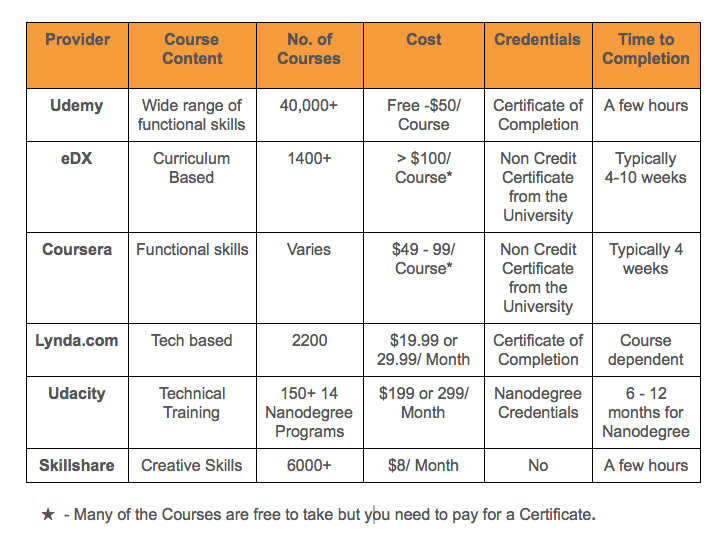
To begin, evaluate the features of a few online learning sites that provide short-term courses and certificates with various content, fees, and time commitments, and then go through the details.
Feature Comparison of Online Learning Websites
Udemy
Udemy’s options are vast, with over 40,000 courses ranging from business to personal development, as well as functional skills such as technology, wellness, and photography. Their website, which uses a video-based lecture style, boasts 11 million members from 190 countries. Udemy provides a simple sign-up process and a user-friendly layout.
The cost of a course normally varies from 0 to $50.
edX
Certified courses from leading universities are available through edX. You can choose from over 950 online courses to help you finish your high school diploma or earn certificates. The courses cover a wide range of academic fields, including architecture, chemistry, philosophy, languages, and social sciences; many are free, but there is a cost for a signed and verified certificate from one of the main partner schools. Courses can be self-paced or have set start and finish dates.
Costs: While a course may cost $100 or more, a certificate from the school signed by the instructors can be a significant credential at a job interview or in the workplace.
Coursera
Coursera, like edX, syndicates courses from top educational institutions throughout the world and teaches them by official university professors. Most courses are available for free, or you can pay to complete them and obtain a certificate of completion. Some of these certificates can be used to earn credits in academic programs or technical training courses, but if you need college credit, double-check the requirements ahead of time. Again, you have the option of going at your own pace, though most courses have set start dates.
The cost of each course varies from $45 to $99.
Linkedin learning
LinkedIn Learning is another educational website that focuses on employability skills for today’s digital workplaces, such as computer programming, audio engineering, graphic design, videography, office software proficiency, and meeting/presentation management, with 2200 courses and 4 million students. The courses are primarily video-based, with features such as the option to search video transcripts for something specific you want to learn about, as well as the opportunity to add specific videos to your own personalized playlists. It also offers a program that allows libraries and other educational organizations to borrow it for free.
Costs: Linkedin Learning features two monthly membership models: Basic ($19.99) and Premium ($29.99), with a free trial period for consumers to evaluate the course content.
Udacity
Udacity has fewer (but it does provide paid course packages that can be used to fulfill technical training program requirements). What sets Udacity apart is that its courses are developed in collaboration with leading technology companies such as Google, Facebook, and Salesforce. Beginner-level courses require little prior knowledge of technology, and as a student gains confidence, he or she can progress to more advanced materials.
Costs: You can test out the free courses or enroll in the $199/month career-track Nanodegree courses. If you’re seeking a specialized career in a specific industry, look for the $299/month Nanodegree plus courses, which come with a job guarantee.
Skillshare
Skillshare claims itself as a place to develop creative talents, and it currently has 1.8 million users.
Culinary, Design, Art, Photography, and Writing courses are available.
Many of the courses are taught by experts in their disciplines who make their living teaching the subject matter. Barbara Corcoran, a real estate businesswoman, Marc Ecko, a fashion designer, and Gary Vaynerchuk, a social media strategist, are among the notable Skillshare instructors.
They offer a project-based learning structure that includes video, projects, and interactive instruction, as well as a weekly newsletter with information about upcoming classes.
Costs: Offers a free membership (access to roughly 600 courses) or a premium membership (access to 5600+ courses) for $8 per month.
The preceding list is by no means complete. Other online and classroom sites that offer job-related or personal-value skills abound.
Read ALSO:
Empower yourself – 10 communication skills for online job
How to Learn a New Skill for Free
Bloggers must have these SEO skills to grow their blog in 2022
Tips:
Take notes during lectures and continue to examine old topics once you’ve started a course. Use all of the materials available on the site, which include an organized style, open resources, and a discussion area where you may ask questions and form study groups to review and learn.
Are you hesitant to begin? It’s like getting back on a bike – once the wheels start rolling, the sense of accomplishment propels you forward. The best part is that you can learn while cooking supper from the comfort of your own home, using a laptop on your kitchen counter. If you still can’t do it alone, enlist the help of a friend.
So go ahead and choose a course that suits you. The main drawback is the limited time and financial commitment, but consider the possibilities if you enjoy what you learn.